If you own or manage a restaurant in Virginia, you already know that health inspections are serious business. A poor inspection means violations you have to fix on a deadline, and a report any customer can look up online.
What many restaurant owners don't realize is that restrooms and handwashing sinks are part of every health inspection. Virginia's Food Regulations set rules for toilet rooms, handwashing supplies and when employees wash their hands, and some of those rules fall in the two most serious of the three violation tiers.
This guide covers what Virginia requires, where restaurants often fall short, and how to build a compliance program that keeps you in the clear.
What Virginia law actually requires
Virginia's Food Regulations (12VAC5-421) are based on the FDA Food Code, the 2022 edition since September 10, 2026. The Virginia Department of Health (VDH) enforces them through local health districts. When it comes to restrooms and handwashing, the requirements are specific.
Handwashing stations
Every restaurant must have handwashing stations that are:
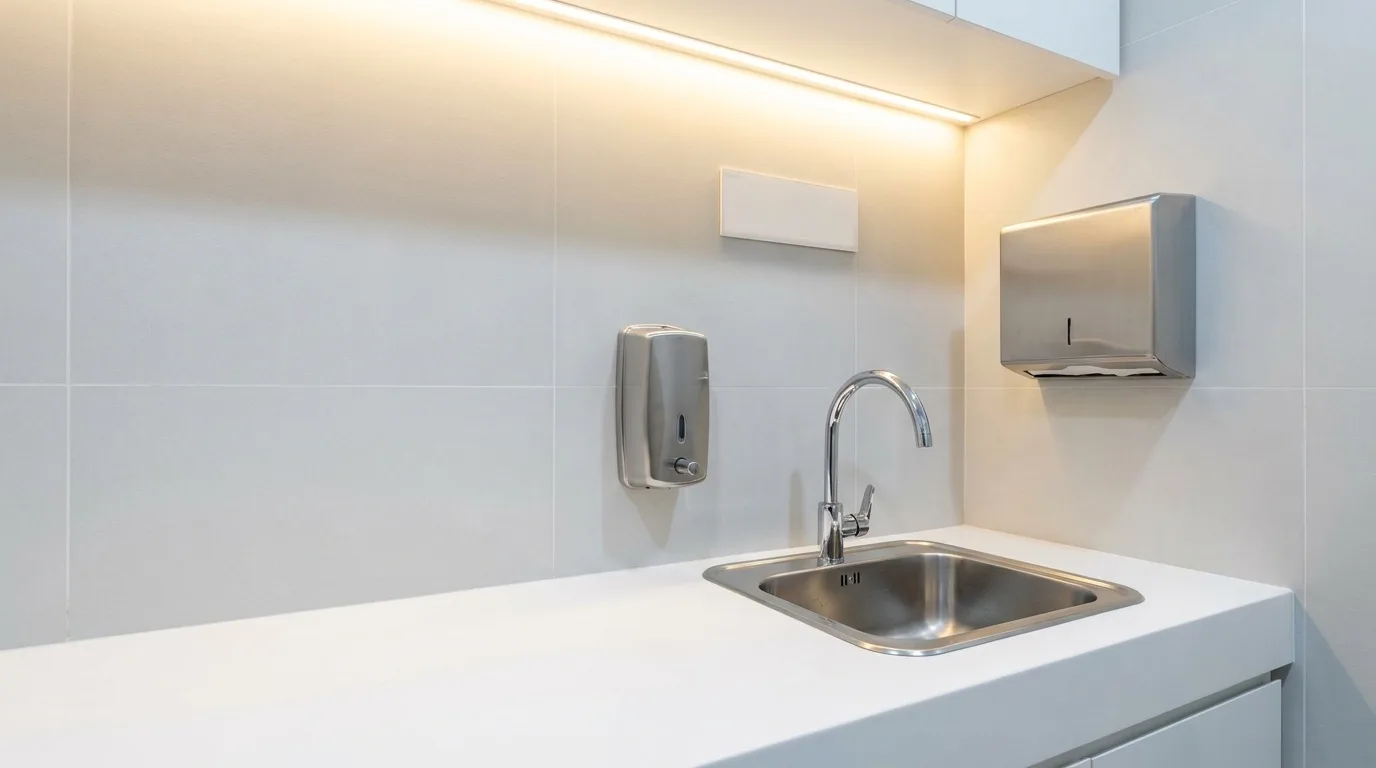
- Where employees need them — convenient to food prep, food dispensing and warewashing areas, and in or right next to every toilet room (12VAC5-421-2280)
- Properly supplied — soap, plus disposable towels, a continuous towel system or a hand dryer, and water of at least 85°F (12VAC5-421-3020, -3030 and -2190)
- Unobstructed — accessible at all times and used for nothing but handwashing, so never blocked by equipment or supplies (12VAC5-421-2310)
- Signed — a clearly visible sign or poster reminding food employees to wash their hands at every handwashing sink they use (12VAC5-421-3045)
Customer restrooms
Virginia's statewide building code requires restrooms for customers in most restaurants. The main exception is a takeout or pickup space whose public area is 300 square feet or less. Customers must be able to reach the restroom without walking through the kitchen or other food prep areas, and it has to be open whenever the restaurant is. The same supply rules apply there: toilet tissue at every toilet, a handwashing sink with soap and a way to dry hands, and a covered receptacle for sanitary napkins in women's restrooms.
Maintenance and cleanliness
Beyond supplies, VDH inspectors evaluate the overall condition of your restrooms. They look for:
- Clean floors, walls, sinks and toilets, cleaned as often as necessary to keep them clean (12VAC5-421-3180, -3240)
- Plumbing and fixtures in good repair, with no leaks and proper drainage (12VAC5-421-2350, -3170)
- Ventilation that keeps odors and moisture from building up
- Toilet rooms fully enclosed, with tight-fitting, self-closing doors kept closed (12VAC5-421-2920, -3250)
- Adequate lighting
Stay Inspection-Ready Every Day
Loyal keeps your restrooms stocked and compliant so you can focus on your kitchen, your customers, and your business.
Schedule My Free ConsultationThe most common restroom violations
After 47+ years of working with restaurants across the DMV, we've seen the same violations come up again and again. Here are the ones that catch restaurant owners off guard the most.
Empty soap dispensers
It sounds almost too simple to be true, but an empty soap dispenser is one of the easiest violations to pick up. Most restaurants rely on staff to check and refill dispensers, and during a busy service, it simply gets forgotten. No soap at a handwashing sink is a priority foundation violation, the middle of the three tiers (12VAC5-421-3020).
No paper towels or drying materials
If your air dryer breaks and you don't have backup paper towels, you're in violation. Inspectors need to see a working way to dry hands at every handwashing sink (12VAC5-421-3030). Many restaurants in Prince William County and throughout Northern Virginia have learned this lesson the hard way.
Handwashing sinks used for other purposes
This is a priority foundation violation. Handwashing sinks can only be used for handwashing, and they have to stay accessible at all times (12VAC5-421-2310). Food prep, washing dishes, dumping liquids, or stacking supplies in or in front of the sink all break the rule.
Missing or inadequate signage
Every handwashing sink food employees use needs a clearly visible sign or poster reminding them to wash their hands (12VAC5-421-3045). A missing sign is a core violation, the least serious tier, but it's also the easiest one to avoid.
Broken or malfunctioning equipment
Virginia's regulations require your facilities and plumbing to be kept in good repair (12VAC5-421-3170 and -2350). Dripping faucets, broken toilet seats, broken soap dispensers, and cracked mirrors can all end up on the inspection report, even when they seem cosmetic.
What a VDH inspection looks like
Understanding the inspection process helps you prepare for it. VDH inspects most restaurants at least once every six months, or on a schedule based on their risk level (12VAC5-421-3800). The inspector evaluates your entire operation, restrooms included, and leaves you a copy of the report.
Each requirement in the regulations falls into one of three tiers, which set how fast a violation has to be fixed (12VAC5-421-3930 and -3950):
Directly related to foodborne illness risk (e.g., an employee not washing their hands after using the toilet). Corrected during the inspection, or within 72 hours if the inspector allows.
Support systems that prevent priority violations (e.g., no soap or no way to dry hands at a handwashing sink). Corrected during the inspection, or within 10 days if the inspector allows.
General sanitation and maintenance issues (e.g., a missing handwashing sign, a cracked mirror, stained ceiling tiles). Corrected by a date the inspector sets, within 90 days.
Never Get Cited for Empty Dispensers
Our scheduled service ensures your soap, paper, and sanitizer are always stocked. Free dispensers, no contracts.
Get a Free QuoteBuilding a compliance routine that works
Passing inspections isn't about cramming the night before. It's about building daily habits that keep your restrooms consistently compliant. Here's a practical approach:
Daily checks (opening and mid-shift)
- Verify soap, paper towels, and toilet paper are stocked in all restrooms and handwashing stations
- Test all dispensers to make sure they're dispensing properly
- Clean and sanitize all restroom surfaces
- Check that signage is in place and legible
- Confirm restroom doors are self-closing and latching
Weekly checks
- Inspect plumbing for leaks or drainage issues
- Check ventilation fans for proper operation
- Inventory backup supplies
- Deep clean grout, fixtures, and hard-to-reach areas
Work with a reliable supply partner
The most inspection-ready restaurants we work with don't leave supply management to chance. They partner with a commercial hygiene provider who delivers on a set schedule, monitors usage, and ensures dispensers are always functional.
This is exactly what Loyal does. We install commercial-grade dispensers at no cost, deliver supplies on a regular schedule matched to your usage, and replace any equipment that breaks, also at no cost. When your inspector walks in, your restrooms are ready.
The cost of non-compliance
A bad inspection costs more than the time it takes to fix the violations:
- Inspection reports are public — VDH posts them online, where any customer can look them up
- Corrections take time — violations have to be fixed by a deadline, and the inspector may come back to check
- Customer trust erodes — a report full of restroom violations can undo years of reputation building
Keeping your restrooms reliably stocked costs far less than the business a bad report can cost you.
Your restroom is part of your kitchen's reputation
There's an old restaurant industry saying: the bathroom tells you everything you need to know about the kitchen. Your customers believe it. Your health inspector believes it.
Whether it's fair or not, it shapes how people perceive your entire operation.
The good news is that restroom compliance isn't complicated. Keep your dispensers full, your surfaces clean, your equipment functional, and your signage visible. Partner with someone who makes that easy, and inspections become a non-event.
Loyal has been helping Virginia restaurants stay inspection-ready since 1979. If your current setup isn't cutting it, we'd be happy to show you what reliable service looks like. Call us at (703) 361-7888 or request a free consultation below.
Related reading: Why Your Restroom Is Your Business's First Impression
Keep your restaurant inspection-ready
Free dispensers, scheduled service, and a partner who understands Virginia compliance.
Schedule my free consultationFree Resource: Download our Virginia Restroom Compliance Guide — VOSH, Virginia's Food Regulations, the statewide building code, ADA requirements and a printable daily check log.